Navigating the Complexity of Australian University Assessments: A Strategic Guide for Students
The Australian higher education landscape is renowned globally for its rigour and high academic standards. However, for domestic students at the University of Melbourne or international cohorts at UNSW, the transition into this system often reveals a sophisticated web of expectations. From the strict adherence to the Australian Qualifications Framework (AQF) to the nuanced demands of TEQSA (Tertiary Education Quality and Standards Agency) regarding academic integrity, “getting by” is no longer a viable strategy for success.
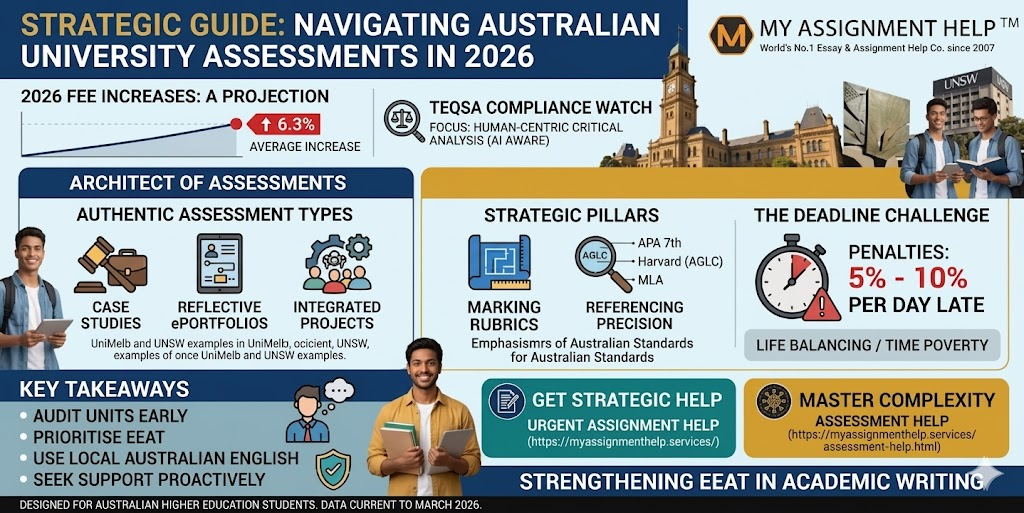
In 2026, the Australian university sector has seen a projected 6.3% to 6.9% increase in student contribution amounts. This creates unprecedented financial and emotional pressure to perform. Assessments are no longer just about testing knowledge; they are designed to evaluate critical thinking and professional readiness. Because these pressures often peak simultaneously across the semester, many students often seek urgent assignment help in Australia to align with TEQSA standards and ensure their submissions meet the high bar of academic honesty and technical precision.
The Architecture of Australian Assessments
Understanding the “why” behind your task is the first step toward mastery. Leading universities like Monash and the University of Sydney are increasingly moving toward “Authentic Assessment” models designed to simulate workplace challenges.
1. The TEQSA Influence and Academic Integrity
TEQSA’s Revised Academic Integrity Toolkit (March 2026) focuses heavily on “human-centric” critical analysis. To rank in the high-distinction (HD) tier (80%+), students must demonstrate a unique scholarly voice that moves beyond descriptive writing into evaluative territory.
2. The Shift Toward Authentic Assessment
- 2020: Traditional Essays & Exams (High AI Risk)
- 2026: Viva Voces, ePortfolios, and Integrated Case Studies (Low AI Risk, High Critical Thinking)
Modern assessments are shifting away from traditional exams. You are more likely to face:
- Interactive Oral Assessments: Unscripted conversations framed around workplace scenarios.
- Reflective ePortfolios: Used extensively in UniMelb’s education and health programs.
- Integrated Case Studies: Cross-disciplinary tasks common in Business and Law faculties.
Strategic Pillars for Academic Excellence
To navigate these complexities, students must adopt a professional mindset. This involves decoding the marking rubric—a document that contains the literal “blueprint” for your marks.
- Understanding Rubrics: At UNSW, “unacceptable grounds for review” include a lack of language proficiency. Therefore, precision in academic English is a non-negotiable prerequisite.
- Referencing Precision: Whether it is APA 7th, Harvard (AGLC), or MLA, Australian institutions have zero tolerance for referencing errors. Precision here signals to the marker that you respect the academic conversation.
For many students balancing part-time work with full-time study, the technicality of these rubrics can be overwhelming. This is where professional assessment help provides a strategic advantage, offering a blueprint of how to structure arguments that align specifically with Australian university expectations.
Data-Driven Challenges: Why Students Struggle in 2026
Recent reports from Universities Australia indicate that student load management has become more difficult as universities tighten financial and regulatory compliance.
| Challenge Factor | Impact on AU Students | Strategic Solution |
| Increased Regulation | Stricter “Genuine Student” (GS) visa requirements. | Maintain high GPA through consistent effort. |
| High Stakes Weighting | Single assessments at Monash often worth 50%+. | Early drafting and expert review. |
| Rising Education Costs | Fees rising 2–3x higher than inflation. | Maximising “value per unit” with high marks. |
| Institutional Rigour | Specific “Hurdle Requirements” at UniMelb. | Tailoring work to specific faculty handbooks. |
Key Takeaways for 2026 Students
- Audit Your Units Early: Check the “Learning Outcomes” in your handbook; these are what your assessments actually test.
- Prioritise E-E-A-T: Ensure your sources demonstrate Experience, Expertise, Authoritativeness, and Trustworthiness.
- Use Local English: Always set your word processor to English (Australia) to ensure “s” vs “z” consistency (e.g., organise, not organize).
- Seek Support Proactively: Expert guidance is a tool for learning, not a shortcut.
Author Profile: Dr. Julian Sterling
Senior Academic Consultant at MyAssignmentHelp
Dr. Julian Sterling holds a PhD in Education from a leading Australian university and has over 12 years of experience in curriculum design. Currently serving as a Senior Strategist at MyAssignmentHelp, Julian specialises in helping students bridge the gap between secondary school writing and the rigorous demands of the AQF. He is a frequent contributor to educational forums focusing on academic integrity and the evolution of student support services in the APAC region.
Frequently Asked Questions (FAQ)
1. Is it legal to use assignment help in Australia?
Yes. Seeking academic support and model papers for research is a common practice. However, students must use these resources to inform their own original work and adhere to their university’s academic integrity policies regarding “contract cheating” laws.
2. How do Australian universities detect AI-generated content in 2026?
Most Australian institutions use Turnitin’s updated AI-writing indicator. Markers also look for a lack of “local” context—such as failing to mention specific Australian legislation or using US-centric terminology.
3. What happens if I miss a deadline at a university like UNSW?
Without “Special Consideration,” most universities apply a penalty of 5% to 10% of the total marks per day late. This makes proactive planning essential for students facing unexpected life events.